15 Nov
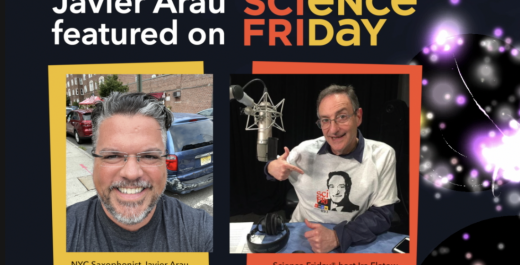
NYJA Founder Javier Arau on SCIENCE FRIDAY: What is Swing in Jazz?
Public Radio International recorded a segment on the nationally syndicated program SCIENCE FRIDAY examining what is swing in jazz. Science Friday sought out two experts, one coming from a physics angle and the other coming from an artistic angle. The episode aired to viral acclaim and featured Dr. Theodore Geisel and New York Jazz Academy’s very own director and founder, saxophonist Javier Arau.
SCIENCE FRIDAY — SEGMENT SCRIPT & TRANSCRIPT
Title: What Is This Thing Called Swing?
Host: Ira Flatow
Guests: Dr. Theodore Geisel (physicist), Javier Arau (saxophonist)
IRA FLATOW: This is Science Friday, I’m Ira Flatow. Also joining me is Javier Arau a saxophonist and the founder and executive director of the New York Jazz Academy based here in New York City. Javier, welcome to Science Friday.
[MUSIC PLAYS (Louis Armstrong):] What is this thing called swing? What is this thing called swing? Is it jazz or drag time futuristic ragtime? What is this thing called swing.?
IRA FLATOW: Louis Armstrong’s 1930s rendition of What is this Thing Called Swing echoes a question that has mystified jazz musicians for a century: Just what is this thing called swing? Well you might say that swing is a propulsive groovy feeling that makes you want to move with the music It’s hard to put into words but if you listen to jazz you’ve probably felt it yourself And now scientists are trying to arrive at a more exact definition of swing and in research published in Nature Communications Physics they have concluded that a key ingredient may be tiny timing differences between a group’s soloist and its rhythm section Downbeat delays they say are a key component of swing jazz Here with an upbeat explanation of the downbeat is one of the scientists who studied jazz: Theo Geisel Professor of Theoretical Physics at the University of Göttingen and the Max Planck Institute for Dynamics and Self-Organization in Göttingen Germany Dr Geisel studies the physics of synchronization His background as a jazz musician sparked an interest in how timing affects musical perception Also joining me is Javier Arau a saxophonist and the founder and executive director of the New York Jazz Academy based here in New York City. Theo, Javier, welcome to Science Friday.
JAVIER ARAU: Ira thank you for having me
THEO GEISEL: Thanks It’s a pleasure
IRA FLATOW: Javier how do you define swing Is it definable Is it definable
JAVIER ARAU: I think this is sort of the Holy Grail And the idea of tying this into science is something that really thrills me Swing is very enigmatic and it’s very very personal so I do feel that people find swing in different ways But I will agree — when you hear it, you know it.
IRA FLATOW: Hmm How does swing make you feel You say when you hear it you know it
JAVIER ARAU: Uh I’m gonna say — swing makes me happy. It really is something when the music is swinging it’s something very deeply satisfying and from there it can become almost cathartic I think It’s something that no matter if it’s Louis Armstrong or Charlie Parker or modern players everyone is reaching the highest quality swing we can in jazz And swing by the way transcends jazz You can find swing in all sorts of music Um it’s definitely an attitude and a confidence not just the way that the beat relates in the music.
IRA FLATOW: Okay I’m gonna play 2 brief clips from the same song and after hearing both of them I want both of you to tell me which one you think swings more Let’s hear the first clip ……… Okay Now the second clip ……… Hmm Javier what do you think
JAVIER ARAU: Uh-oh, okay, the pressure’s on. I’m going to put in I’m gonna put in my vote for — number 2!
IRA FLATOW: Why is that?
JAVIER ARAU: Goodness, so look, I’m coming at this not from a science angle just as as a saxophonist and I felt like number 2 the downbeats really connected a bit more strongly I felt like there was more You mentioned propulsion at the beginning Um I think that’s a great word I would also say the right propulsion can lead to more momentum- Hmm and momentum is one of the things that makes jazz to me really really thrilling So I sensed the second one the pianist’s downbeats were a little more connected to where the bassist and drummer were connecting Now just so I’m understanding the the bass and drums it sounded like perhaps that was a computer recording or like a MIDI performance and then the pianist was live. Is that-
IRA FLATOW: That’s true yes Is that what I was hearing Or Yeah Yes They ’cause these are actually clips Theo that you used in your research right?
THEO GEISEL: Yes.
IRA FLATOW: What’s the difference between them? Now ni- give us the answer.
THEO GEISEL: We manipulated the timing in MIDI recordings in various ways and had professional and semi-professional jazz musicians rate how much swinging these different manipulations th- these different recordings were In the recording you just played we had one version without any delays one version were only the downbeats were delayed the off-beats were synchronized with the rhythm section.
IRA FLATOW: Delaying the downbeats — what did that do? Did that enhance the the swing feel?
THEO GEISEL: Yes Well that’s what we found Um first I should say thereThere are of course several ingredients several components that contribute to swing And the most obvious one that everybody can hear is the so-called swing ratio or it’s the ratio between downbeats and off-beats Some people even believe that that this is swing and that’s all but jazz musicians know that this is not the case There is more to it as Javier just explained.
IRA FLATOW: And and you found that delaying the downbeat I’m reading from your paper made it seven and a half times more likely that a jazz musician would rate the recording as swinging right?
THEO GEISEL: That’s it. Exactly.
IRA FLATOW: But only delaying the downbeats If we delay both downbeats and off-beats then it doesn’t make a difference There it it doesn’t increase or enhance the swing feel How do you how do you react to that Javier D- Do you notice yourself doing this when you play?
JAVIER ARAU: You know anecdotally I think back to when I was first learning jazz you know take I’m thinking back when I was 13 14 years old I was a very excited player and I had so many mentors who would hear me play and say “Javier you gotta just calm down. You gotta relax when you play.” And so you know I’m hearing this and it makes perfect sense to me because I do feel as jazz musicians we’re maintaining a certain awareness that’s very high Yet at the same time we really have to approach the music in a in a really relaxed state That’s hard to achieve because so much in music performance takes a a critical ear very quick thinking I think a next step reasonably is to include say a live bassist to play that walking bass line to play those downbeats because ultimately the beat is is alive It’s a very human element And just the way 2 musicians interact maybe that is the next step Um I’m curious what happens after these studies you know.
THEO GEISEL: I fully agree would be worthwhile having several musicians play simultaneously but that’s very difficult because the bass has so low frequencies it is much more difficult to determine the tone onset of the bass.
IRA FLATOW: What about vocalists? Do they do the same thing?
THEO GEISEL: Well we could do that but as I said it’s much more complicated determining the tone onsets with vocalists and especially with bass it’s much more complicated Uh it’s very tedious and and not as accurate.
JAVIER ARAU: Yeah I can imagine because piano it’s essentially a percussion instrument So you have in MIDI terms key on key off You can measure that But if you If I think about any vocalist there are aspirations there’s diction you know what is the actual note When does it start It’s the same thing for us on saxophone How do we know exactly where that beat starts It’s hard to say.
IRA FLATOW: Hmm Javier do these new findings change how you might teach jazz to your students?
JAVIER ARAU: What I love is that it’s quantified a bit and that’s always helpful I think in teaching to be able to point students in the direction of this scientific research And I think it’s fortunate that it does support what jazz musicians have been saying for a long time I mean I’ve never met a jazz musician who says “Oh no no no no play ahead of the beat,” you know That’s not something that’s really common And and this this goes back you know for decades and decades.
IRA FLATOW: Gentlemen I have run out of time I wanna thank both of you Theo and Javier for taking time to talk with us today. Excellent discussion.
JAVIER ARAU: Well it’s been such a pleasure. Thank you for having us, Ira.
THEO GEISEL: It was a pleasure for me, too.
IRA FLATOW (outro/credits): Theo Geisel Professor of Theoretical Physics at the University of Gottingen and the Max Planck Institute for Dynamics and Self-Organization in Gottingen Germany Javier Arau a saxophonist and the founder and executive director of the New York Jazz Academy based in New York City.
[MUSIC PLAYS:] Yes it don’t mean a thing if it ain’t got that swing.
IRA FLATOW: If you like that jazz piece or the conversation with Carolyn Bertozzi this hour you can thank our former NSF fellow Jason Dinh whose hard work made them possible Here’s Kathleen Davis with some of the other folks who helped make this show happen.
KATHLEEN DAVIS: Thanks Ira Nahima Ahmed is our manager of Impact Strategy Velissa Meyers is our office manager Annie Nero is our individual giving manager Charles Berquist is our radio director And I’m Kathleen Davis radio producer.
Thanks for listening.
[MUSIC PLAYS:] It don’t mean a thing.
IRA FLATOW: BJ Lederman composed our theme music And if you missed any part of the program or you’d like to hear it again subscribe to our podcasts. Have a great weekend. I’m Ira Flatow.
[MUSIC PLAYS:] If it ain’t got that swing boy I said don’t mean a thing.
Are you wondering if New York Jazz Academy® is right for you? There’s only so much you can learn by visiting a website, so feel free to contact us for an honest assessment. Also, feel free to read about other NYJA® musicians’ stories and testimonials, and check out our post helping answer the question, “Is NYJA® Right For You?”.